
No products in the cart.









Understanding Japa: One of the Oldest Meditation Practices in the World
In an age filled with notifications, endless scrolling, constant distractions, and increasing mental stress, many people are searching for ways to reconnect with silence, focus, and inner peace. Some discover mindfulness. Others explore breathwork. Many turn toward yoga. Yet one of the oldest and most powerful meditation practices continues to quietly transform millions of lives across India and around the world: Japa.
The word “Japa” originates from Sanskrit and generally refers to the repeated recitation of a sacred mantra, divine name, prayer, or spiritual sound. While the practice is deeply rooted in Hindu traditions, it has influenced spiritual disciplines across multiple schools of yoga, Vedanta, Bhakti, Tantra, and meditation systems.
Whether someone repeats “Jai Shri Ram,” chants the Hare Krishna Mahamantra, recites Gayatri Mantra, or meditates upon Om Namah Shivaya, they are engaging in a form of Japa.
At its heart, Japa is not merely repetition.
It is a process of directing the mind toward a sacred focus until concentration deepens into awareness, awareness deepens into devotion, and devotion gradually transforms the practitioner.
For beginners, Japa is often the easiest doorway into meditation because it provides the mind with a clear anchor. Rather than struggling to stop thoughts completely, the practitioner continuously returns attention to the mantra.
This simple process has made Japa one of the most enduring spiritual practices in human history.
What Is Japa in Hinduism?
One of the most frequently searched questions online is: “What is Japa in Hinduism?”
In Hindu philosophy, Japa refers to the repeated chanting, whispering, or mental repetition of a sacred mantra. The mantra may be associated with a specific deity, spiritual principle, guru tradition, or divine vibration.
The purpose of Japa extends beyond merely counting repetitions.
Traditional scriptures describe Japa as a means of purifying the mind, cultivating concentration, developing devotion, reducing mental agitation, and strengthening one’s connection with the Divine.
Across different Hindu traditions, practitioners engage in various forms of Japa dedicated to:
Lord Rama
Lord Krishna
Lord Shiva
Maa Durga
Hanuman Ji
Gayatri Devi
Vishnu
Lakshmi
Personal Guru Mantras
Vedic Mantras
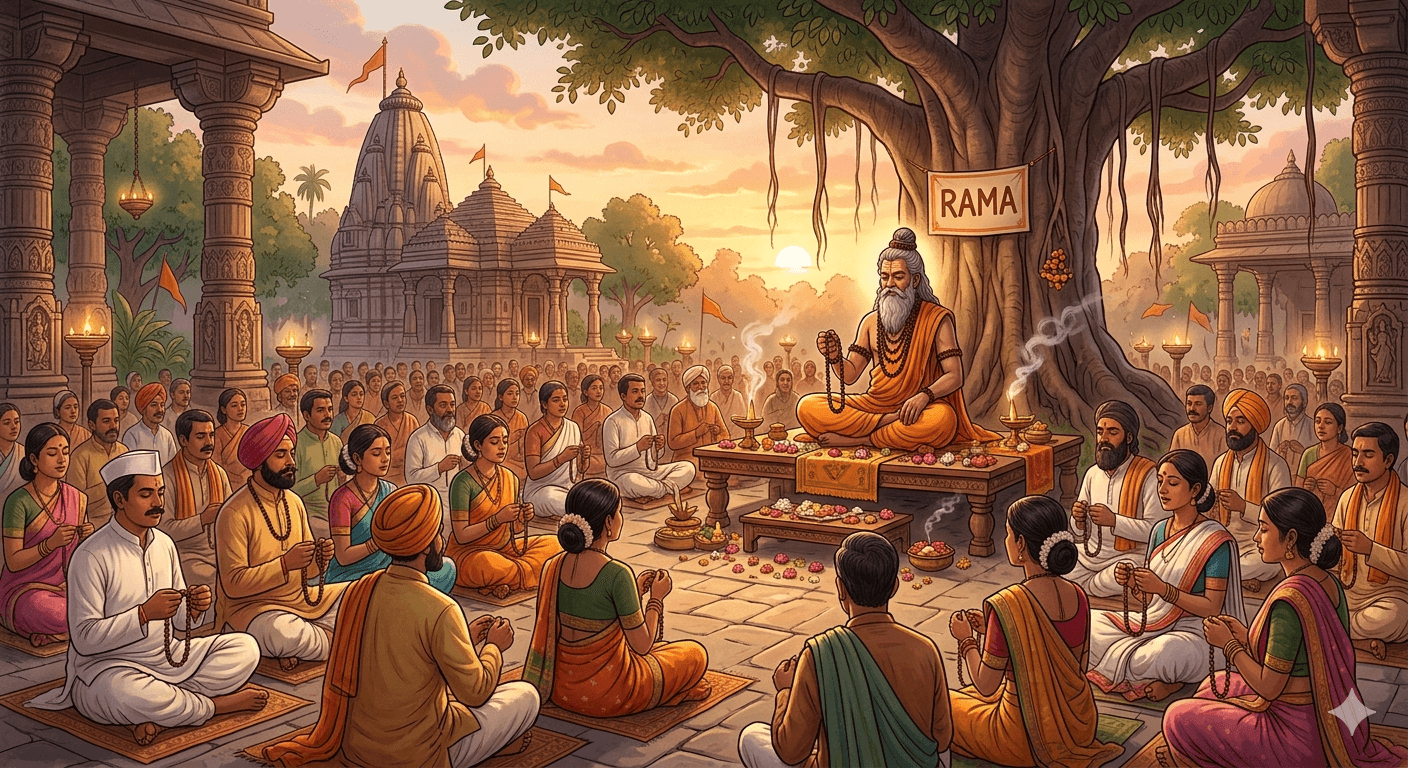
The practice may be performed individually, within families, during temple gatherings, as part of daily sadhana, or during special observances such as Navratri, Shravan, Ekadashi, Kartik month, or pilgrimage journeys.
For many devotees in Ayodhya, Vrindavan, Varanasi, Chitrakoot, Haridwar, and countless spiritual centers across India, Japa remains a daily discipline woven into everyday life.
What Is Japa Mantra Meditation?
Another common question is: “What is Japa mantra meditation?”
Japa mantra meditation is a meditative practice where attention is repeatedly brought back to a chosen mantra.
Unlike silent meditation methods that ask practitioners to observe thoughts without a focal point, Japa meditation actively uses a sacred sound as the object of concentration.
The mantra becomes an anchor.
Every repetition helps redirect attention away from distractions and back toward awareness.
Over time, the mind begins to settle naturally.
The mantra gradually occupies less physical effort and more mental space.
This creates a state where concentration becomes easier, emotions become calmer, and spiritual awareness becomes more accessible.
Many practitioners describe Japa meditation as one of the most beginner-friendly forms of meditation because the mantra provides structure to the experience.
Rather than wondering whether meditation is being done correctly, the practitioner simply returns to the mantra.
How Does Japa Meditation Actually Work?
From a practical perspective, Japa works by engaging attention repeatedly.
The human mind constantly moves between memories, plans, worries, desires, conversations, and distractions.
Japa gently interrupts this cycle.
Every repetition acts like a reset.
Instead of allowing thoughts to wander indefinitely, attention returns to the sacred sound.
Modern neuroscience increasingly explores how repetitive focused attention influences mental states, concentration, stress regulation, and emotional processing.
Ancient yogic traditions understood this through direct experience long before scientific instruments existed.
The sages observed that repeated engagement with sacred sounds gradually influences mental tendencies, emotional responses, and patterns of awareness.
As concentration strengthens, practitioners often experience greater clarity, patience, emotional stability, and spiritual sensitivity.
The Meaning of Mantra in Japa Practice
To understand Japa fully, it is important to understand what a mantra actually is.
A mantra is not simply a motivational phrase.
In traditional Hindu understanding, a mantra is considered a sacred sound formula carrying spiritual significance and transformative potential.
The Sanskrit roots are often interpreted as:
“Man” referring to mind.
“Tra” referring to liberation, protection, or instrument.
Thus, mantra may be understood as an instrument for guiding, protecting, or transforming the mind.
Different traditions assign different mantras for different purposes.
Some mantras emphasize devotion.
Some emphasize wisdom.
Some focus on protection.
Others cultivate compassion, prosperity, courage, or spiritual awakening.
The effectiveness of a mantra is generally believed to arise from sincere repetition, proper intention, consistency, and devotion rather than mere mechanical counting.
What Are the Four Types of Japa?
One of the most searched spiritual questions is: “What are the four types of Japa?”
Traditional teachings commonly describe four primary forms of Japa.
Vaikhari Japa
Vaikhari Japa involves audible chanting.
The mantra is spoken clearly enough to be heard by the practitioner and sometimes by nearby individuals.
This form is often recommended for beginners because it helps maintain concentration and reduces mental wandering.
Temple kirtans, group chanting sessions, and many devotional practices include elements of Vaikhari Japa.
Upanshu Japa
In Upanshu Japa, the mantra is whispered softly.
The lips move, but the sound is barely audible.
This creates a more inward and concentrated experience compared to loud chanting.
Many practitioners gradually transition from Vaikhari Japa to Upanshu Japa as concentration develops.
Manasika Japa
Manasika Japa involves silent mental repetition.
The mantra is repeated entirely within the mind.
Traditional teachings often consider this one of the most subtle and powerful forms of Japa because concentration becomes highly refined.
However, beginners may find it more challenging because there is no audible anchor.
Likhita Japa
Likhita Japa refers to writing the mantra repeatedly.
Ram Naam writing books, Krishna Naam notebooks, and devotional writing practices all fall within this category.
Many devotees find that writing combines physical action, visual focus, and mental repetition in a uniquely powerful way.
What Is the First Stage of Mantra Japa?
Many beginners ask: “What is the first stage of mantra Japa?”
The first stage is often described as deliberate repetition with conscious effort.
At this stage, concentration frequently wanders.
The practitioner forgets counts.
Thoughts interrupt the process.
The mind resists staying focused.
This is completely normal.
Every experienced practitioner has passed through this stage.
The goal is not perfection.
The goal is consistency.
Over time, repetition becomes easier.
Attention returns more naturally.
The mantra begins to feel familiar rather than forced.
Eventually, many practitioners report that the mantra continues to arise spontaneously even outside formal practice sessions.
Traditional teachers sometimes refer to this progression as the mantra gradually becoming established within consciousness.
Why Japa Has Remained Relevant for Thousands of Years
Many spiritual techniques have emerged and disappeared throughout history.
Japa has endured because it is simple, adaptable, accessible, and deeply personal.
A wealthy businessman and a village farmer can both practice it.
A student and a monk can both practice it.
A beginner and an advanced practitioner can both benefit from it.
The practice requires no expensive equipment, no special location, and no complex rituals to begin.
All that is required is sincerity, consistency, and a willingness to return attention to the mantra again and again.
That simplicity explains why Japa continues to remain central to spiritual life across generations.
Japa Meditation Benefits: Why Millions Continue This Ancient Practice Today
One of the reasons people begin exploring Japa is because they hear about its benefits from spiritual teachers, family members, temple communities, yoga practitioners, or personal experiences shared by devotees.
While different traditions explain these benefits differently, certain themes appear repeatedly across centuries of spiritual literature and lived experience.
The first benefit often reported is improved mental focus. Modern life constantly pulls attention in multiple directions. The mind jumps from one thought to another, from one notification to another, from one worry to another. Japa creates a single point of focus. Every repetition of the mantra becomes an opportunity to return attention to the present moment.
A second benefit is emotional steadiness. Many practitioners describe feeling calmer after consistent mantra repetition. The mantra gradually becomes a stabilizing influence during periods of uncertainty, stress, frustration, or emotional turbulence.
A third benefit is spiritual connection. Whether someone relates to Lord Rama, Lord Krishna, Lord Shiva, Devi, Hanuman Ji, or a personal spiritual path, Japa creates regular moments of connection with what they consider sacred.
Another important benefit is discipline. Spiritual growth rarely occurs through occasional bursts of effort. Daily Japa encourages consistency. The simple act of showing up each day and repeating a mantra strengthens commitment over time.
Many devotees also report that Japa creates greater patience, gratitude, self-awareness, and resilience in everyday life.
The most remarkable aspect is that these benefits are not limited to monks or advanced practitioners. Even beginners who practice for a few minutes each day often notice positive shifts in their mental and emotional state.
How to Do Mantra Meditation for Beginners
Among all People Also Ask queries, perhaps the most common is: “How do beginners start mantra meditation?”
The answer is surprisingly simple.
The first step is selecting a mantra that feels meaningful and comfortable. Traditional teachers often recommend choosing one mantra and remaining consistent rather than changing frequently.
For many beginners, commonly used mantras include:
Jai Shri Ram
Om Namah Shivaya
Hare Krishna Mahamantra
Gayatri Mantra
Om Namo Bhagavate Vasudevaya
Sri Ram Jai Ram Jai Jai Ram
Radhe Radhe
The second step is choosing a quiet environment where interruptions are minimal. This does not require a dedicated meditation room. A clean corner of a home, a prayer space, a balcony during sunrise, or even a peaceful park can work well.
The third step is setting a realistic duration. Many beginners make the mistake of attempting extremely long sessions immediately. A more sustainable approach is beginning with five or ten minutes daily and gradually increasing over time.
The fourth step is gently returning attention whenever the mind wanders. Thoughts will arise. Memories will appear. Future plans will emerge. This is natural. Meditation does not require eliminating thoughts. It requires repeatedly returning attention to the mantra.
The final step is consistency. Five minutes daily practiced sincerely often produces more benefit than occasional hour-long sessions.
Choosing the Right Japa Meditation Mantra
Many newcomers wonder whether there is a “best” mantra.
Traditional teachings generally suggest that the best mantra is one that resonates deeply with the practitioner and can be repeated consistently with devotion.
For devotees of Lord Rama, Ram Naam remains one of the most beloved forms of Japa.
For Krishna devotees, the Hare Krishna Mahamantra continues to inspire millions around the world.
For seekers drawn toward inner stillness and transformation, Om Namah Shivaya remains one of the most widely practiced mantras.
For those interested in Vedic traditions, Gayatri Mantra is often regarded as one of the most revered prayers.
The important principle is sincerity rather than complexity.
A simple mantra repeated consistently often becomes more transformative than constantly searching for a perfect mantra without committing to practice.
Understanding the Role of the Japa Mala
A Japa Mala serves as a counting aid during mantra repetition.
Traditionally, a mala contains 108 beads along with a larger guru bead.
Each bead represents one repetition of the mantra.
As the practitioner completes each recitation, the fingers move to the next bead.
This process helps maintain count without requiring mental calculation.
The deeper purpose of the mala, however, extends beyond counting.
The physical movement creates rhythm.
The rhythm supports concentration.
The concentration supports meditation.
The meditation supports spiritual awareness.
This simple sequence explains why malas have remained central to devotional traditions for centuries.
How to Use a Japa Mala for the First Time
Many beginners feel intimidated when they first receive a Japa Mala.
Fortunately, the process is straightforward.
Begin by holding the mala comfortably in the right hand.
The guru bead, which is usually larger or visually distinct, serves as the starting point.
Rather than crossing over the guru bead, practitioners traditionally reverse direction after completing a round.
Each bead is moved individually while repeating the chosen mantra.
There is no need to rush.
The objective is not speed.
The objective is mindful repetition.
Many beginners discover that the physical sensation of moving beads helps anchor attention and reduces distractions.
Over time, the process becomes natural and effortless.
How to Do Mala Japa on Fingers
Another highly searched question is: “How to do Japa on fingers?”
There are situations where a practitioner may not have access to a physical mala. Travel, workplace environments, school settings, or public spaces may make carrying beads impractical.
Traditional systems exist for counting mantra repetitions using finger segments.
The thumb is generally used as the counting finger while touching specific joints and sections of other fingers.
Different traditions use slightly different counting methods.
The principle remains the same: creating a reliable counting system without external tools.
Many devotees today also use digital alternatives such as the AyodhyaShri Online Japa Counter when a physical mala is unavailable.
The goal remains consistent mantra repetition rather than strict dependence upon a particular counting method.
Common Mistakes Beginners Make During Japa
One of the biggest misconceptions about Japa is that success depends upon perfect concentration.
This belief often discourages beginners unnecessarily.
In reality, distraction is part of the learning process.
Some common beginner mistakes include changing mantras too frequently, focusing excessively on speed, becoming discouraged by wandering thoughts, skipping practice for long periods, and treating counting as more important than devotion.
Another mistake is comparing oneself to advanced practitioners.
Someone who has practiced daily for twenty years will naturally experience Japa differently than someone beginning today.
Spiritual growth unfolds gradually.
The most important quality is perseverance.
Every session contributes to progress even when the experience feels imperfect.
Why Consistency Matters More Than Duration
Many spiritual teachers emphasize a principle that surprises newcomers.
Consistency is generally more important than intensity.
A person chanting one mala daily for a year often develops stronger habits than someone who chants ten malas one day and then stops for several weeks.
Regular repetition creates momentum.
The mind becomes familiar with the mantra.
The practice becomes integrated into daily life.
Eventually, Japa stops feeling like a task and begins feeling like a natural part of one’s routine.
This transformation occurs not through occasional effort but through repeated engagement over time.
The Modern Revival of Japa
In recent years, growing numbers of young professionals, students, entrepreneurs, homemakers, and international seekers have rediscovered Japa.
Part of this revival stems from increasing awareness around mindfulness and mental well-being.
Another reason is accessibility.
Unlike many spiritual disciplines, Japa can be practiced almost anywhere.
A devotee can chant while sitting in a temple in Ayodhya.
A student can repeat a mantra quietly before examinations.
A professional can practice during a commute.
An NRI family can maintain devotional traditions while living thousands of miles from India.
The flexibility of the practice makes it remarkably adaptable to modern life while preserving its ancient spiritual roots.
Japa Mala Rules in ISKCON: Understanding the Discipline Behind Daily Chanting
One of the most searched topics related to Japa is “Japa Mala Rules ISKCON.” This reflects the growing interest people have in understanding how mantra meditation is practiced within the Gaudiya Vaishnava tradition.
The International Society for Krishna Consciousness, commonly known as ISKCON, places significant emphasis on daily Japa practice. Followers chant the Hare Krishna Mahamantra on a Tulsi Japa Mala as part of their daily spiritual discipline.
The mantra traditionally recited is:
Hare Krishna Hare Krishna Krishna Krishna Hare Hare
Hare Rama Hare Rama Rama Rama Hare Hare
Within the tradition, chanting is viewed not merely as repetition but as a direct spiritual engagement with the Divine through sacred sound.
Several commonly followed principles include chanting attentively, avoiding unnecessary distractions, treating the mala respectfully, maintaining cleanliness, and striving to hear each mantra clearly.
An important practice is avoiding crossing over the guru bead. After completing one round, practitioners reverse direction rather than crossing the larger bead. This tradition symbolizes respect and remembrance of the spiritual lineage.
For newcomers, understanding these guidelines helps cultivate mindfulness and reverence during practice rather than approaching Japa as a mechanical counting exercise.
Why Hearing the Mantra Is Just as Important as Chanting It
Many beginners assume Japa is only about speaking a mantra repeatedly.
Traditional teachers often emphasize something deeper.
The act of hearing the mantra is considered equally important.
When a practitioner chants and simultaneously listens attentively to the sacred sound, concentration naturally improves.
This principle explains why many experienced practitioners encourage slowing down rather than rushing through rounds.
The goal is not to finish quickly.
The goal is to become absorbed in the sound vibration.
Each repetition becomes an opportunity to reconnect attention with the mantra.
As this process deepens, external distractions lose some of their influence and the practitioner experiences greater inner stability.
Can Japa Be Used for Manifestation?
A growing number of online searches focus on “How to use Japa Mala for manifestation.”
This question often emerges because modern self-development communities frequently discuss manifestation, intention setting, affirmations, and visualization practices.
Traditional Hindu teachings approach the subject somewhat differently.
Japa is generally viewed as a spiritual discipline aimed at purification, devotion, concentration, and divine remembrance.
However, many practitioners do perform Japa while holding a sincere intention or sankalp.
For example, a person may pray for:
Inner peace.
Clarity in decision making.
Strength during challenges.
Protection during difficult periods.
Spiritual growth.
Improved self-discipline.
Guidance from the Divine.
In this context, Japa can support manifestation by helping align thoughts, emotions, and actions with a chosen intention.
The key difference is that traditional teachings emphasize surrender, devotion, and right action rather than attempting to force specific outcomes.
A mantra becomes a vehicle for transformation rather than merely a tool for acquiring material desires.
How to Use a Japa Mala for Manifestation Without Losing Its Spiritual Purpose
If someone wishes to combine intention setting with Japa practice, a balanced approach can be helpful.
Before beginning the session, spend a few moments establishing a clear intention.
This intention should ideally be positive, ethical, and aligned with personal growth.
For example:
May I develop greater patience.
May I become more disciplined.
May my family remain healthy and peaceful.
May I grow spiritually.
May I act with wisdom and compassion.
Once the intention is established, attention returns fully to the mantra.
The mantra remains the primary focus.
The intention simply provides direction.
This approach preserves the spiritual integrity of Japa while allowing practitioners to cultivate meaningful personal goals.
Japa Meditation and the Teachings of Wayne Dyer
Search interest around “Japa Meditation Wayne Dyer” continues to grow because many readers encounter mantra repetition through the teachings of self-development authors rather than traditional Hindu sources.
Dr. Wayne Dyer frequently discussed the transformative power of sacred sounds and repetitive spiritual phrases.
While his teachings drew from multiple traditions, he often emphasized the importance of repetitive contemplative practices for calming the mind and connecting with deeper awareness.
Many readers who discover mantra meditation through Wayne Dyer eventually explore traditional forms of Japa found within Hindu spiritual traditions.
This connection creates an interesting bridge between modern personal development and ancient contemplative practices.
Although the language may differ, the underlying principle remains similar: focused repetition gradually influences consciousness.
What Happens When Japa Becomes Effortless?
One of the fascinating aspects of long-term Japa practice is that it evolves over time.
In the beginning, every repetition requires deliberate effort.
The practitioner remembers the mantra consciously.
Attention frequently wanders.
Distractions interrupt concentration.
With regular practice, a shift often begins to occur.
The mantra becomes more familiar.
Repetition becomes smoother.
Attention returns more quickly after distractions.
Many practitioners describe moments when the mantra seems to continue naturally without requiring constant effort.
Traditional teachings sometimes describe this progression as the mantra gradually becoming established within awareness.
While experiences vary from person to person, the principle remains consistent: repetition eventually creates familiarity, and familiarity creates ease.
Ram Naam Japa vs Krishna Naam Japa: Is One Better?
This question appears frequently in spiritual discussions.
The short answer is no.
Different traditions emphasize different divine names, but the purpose of Japa remains fundamentally similar.
Ram Naam Japa focuses on remembrance of Lord Rama and the qualities associated with Him, including righteousness, courage, devotion, compassion, and ideal conduct.
Krishna Naam Japa focuses on remembrance of Lord Krishna and the qualities associated with divine love, wisdom, joy, compassion, and spiritual intimacy.
For some devotees, family traditions naturally influence their chosen mantra.
Others feel drawn toward a particular deity through personal experience or spiritual inclination.
Traditional teachers generally advise selecting a mantra that inspires genuine devotion rather than worrying about comparisons.
Consistency often matters more than choosing the “perfect” mantra.
What Great Hindu Saints, Rishis, and Spiritual Masters Have Said About Japa
One of the strongest indicators of the importance of Japa is that nearly every major Bhakti, Vedanta, Yoga, and Sanatana Dharma tradition has emphasized the remembrance of the Divine Name. Across centuries, saints, sages, acharyas, and spiritual masters repeatedly taught that sincere repetition of God’s name has the power to transform consciousness and deepen devotion.
Sage Narada on Devotion and Constant Remembrance
The ancient sage Narada, revered as one of Hinduism’s greatest teachers of Bhakti, emphasized uninterrupted remembrance of the Divine as a central aspect of spiritual life. In the Narada Bhakti Sutras, devotion is described as supreme love for God and complete dedication to Him.
One of the core teachings associated with Narada’s path is that devotion deepens when remembrance becomes continuous rather than occasional. Japa serves as one of the most accessible ways to cultivate such remembrance.
Bhagavad Gita on Constant Chanting
In the Bhagavad Gita, Lord Krishna describes the qualities of great souls:
“Always chanting My glories, endeavoring with great determination, bowing down before Me, these great souls perpetually worship Me with devotion.” (Bhagavad Gita 9.14)
This verse is frequently cited by spiritual teachers as evidence that remembrance and repetition of divine names are not peripheral practices but central expressions of devotion.
Sri Chaitanya Mahaprabhu and the Power of the Holy Name
Few figures influenced the revival of Japa and Nama Sankirtana more profoundly than Chaitanya Mahaprabhu.
He repeatedly emphasized the transformative power of chanting the Divine Name during Kali Yuga. Traditional sources associated with his teachings preserve the famous statement:
“There is no other way, no other way, no other way in this age than chanting the holy name of the Lord.”
This teaching became foundational to many Bhakti traditions across India.
Haridasa Thakura: The Saint of the Holy Name
Known within the Gaudiya tradition as Namacharya (Teacher of the Holy Name), Haridasa Thakura dedicated his life to continuous chanting.
Traditional accounts describe him chanting hundreds of thousands of divine names daily. His life remains one of the most powerful examples of unwavering commitment to Nama Japa.
Swami Vivekananda on Bhakti and Divine Love
While explaining Narada Bhakti Sutras, Swami Vivekananda translated the opening teaching:
“Bhakti is intense love for God.”
Japa remains one of the simplest and most practical methods through which that love can be expressed daily.
Modern Saints Who Recommended Naam Japa
Many modern spiritual masters including Ramakrishna Paramahamsa, Ramana Maharshi, Neem Karoli Baba, Anandamayi Ma, and A. C. Bhaktivedanta Swami Prabhupada encouraged remembrance of God through repetition of divine names, mantra meditation, and devotional chanting.
Though their teachings varied in style, they consistently pointed toward the transformative power of sincere spiritual remembrance.
Most Recommended Forms of Naam Japa According to Hindu Scriptures
A common question among beginners is whether any particular divine name or mantra is especially recommended in scripture.
Different traditions emphasize different names, yet several scriptural sources repeatedly glorify the chanting of God’s names during Kali Yuga.
Hari Nama
One of the most widely quoted scriptural teachings comes from the Brihan Naradiya Purana:
“Harer Nama Harer Nama Harer Namaiva Kevalam. Kalau Nasty Eva Nasty Eva Nasty Eva Gatir Anyatha.”
The traditional meaning is:
“In this age of Kali, there is no other way, no other way, no other way than chanting the holy names of the Lord.”
This verse is among the strongest scriptural endorsements of Nama Japa.
Krishna Nama
The Srimad Bhagavatam contains one of the most frequently cited verses regarding chanting:
“Although Kali Yuga is an ocean of faults, there is one great quality. Simply by chanting the names of Krishna, one becomes liberated from material bondage and attains the supreme destination.” (Bhagavatam 12.3.51)
This verse has inspired countless practitioners of Krishna Nama Japa.
Hare Krishna Mahamantra
The Kalisantarana Upanishad presents the sixteen-name Mahamantra:
Hare Krishna Hare Krishna Krishna Krishna Hare Hare
Hare Rama Hare Rama Rama Rama Hare Hare
The text identifies this mantra as a powerful means of spiritual purification during Kali Yuga.
Rama Nama
The chanting of Lord Rama’s name occupies a special place in many Hindu traditions, particularly in North India.
Saints such as Tulsidas repeatedly glorified the remembrance of Shri Rama’s name as a direct path to devotion and spiritual upliftment.
Ram Naam Sankirtan, Ram Naam Lekhan, and Ram Japa continue to be widely practiced in Ayodhya, Chitrakoot, Varanasi, and countless devotional communities.
Om Namah Shivaya
Among Shaiva traditions, “Om Namah Shivaya” is considered one of the most sacred and universally practiced mantras.
Known as the Panchakshari Mantra, it has been recommended for centuries as a path toward purification, devotion, and spiritual realization.
Gayatri Mantra
The Gayatri Mantra remains one of the most revered Vedic mantras.
Traditionally practiced during Sandhya Vandana and daily spiritual discipline, it continues to be among the most widely recited mantras in Hinduism.
The diversity of these traditions demonstrates an important principle: different names and mantras may be emphasized, but the spirit of sincere remembrance remains central.
Japa Around the World: Repetitive Sacred Prayer Across Religions and Civilizations
One reason Japa fascinates scholars, historians, and spiritual seekers is that forms of repetitive sacred prayer appear across many civilizations and religions.
Although terminology differs, the underlying principle of repeated sacred remembrance appears remarkably universal.
Hinduism (1500 BCE and Earlier)
The earliest roots of mantra recitation can be traced to Vedic traditions where sacred sounds, hymns, and mantras were transmitted orally across generations.
Japa evolved into a central spiritual practice within Hinduism, Yoga, Vedanta, Tantra, and Bhakti traditions.
Buddhism (5th Century BCE Onward)
Many Buddhist traditions incorporate repetitive chanting practices.
Examples include:
- Nembutsu in Pure Land Buddhism
- Om Mani Padme Hum in Tibetan Buddhism
- Various sutra recitations across East Asia
These practices often function as aids for mindfulness, devotion, concentration, and spiritual remembrance.
Jainism (Ancient India)
Jain traditions incorporate repeated recitation of sacred formulas such as the Navkar Mantra.
The practice is used to cultivate purity, humility, reverence, and spiritual discipline.
Eastern Orthodox Christianity (Early Centuries CE)
The famous Jesus Prayer:
“Lord Jesus Christ, Son of God, have mercy on me.”
is repeated continuously by practitioners within contemplative traditions.
Prayer ropes are often used in a manner similar to prayer beads.
Roman Catholic Christianity
The Rosary became one of Christianity’s most recognized devotional practices.
Believers repeat structured prayers while moving through beads, creating a practice remarkably similar in form to Japa Mala usage.
Sikhism (15th Century CE Onward)
Naam Simran, the remembrance and repetition of God’s Name, occupies a foundational role in Sikh spirituality.
Continuous remembrance of the Divine Name is considered a path toward spiritual awakening and inner transformation.
Why These Similarities Matter
These parallels do not suggest all traditions are identical.
Each religion possesses its own theology, philosophy, scriptures, and spiritual goals.
However, they reveal something profoundly human.
Across continents and across centuries, people repeatedly discovered that focused repetition of sacred words can help cultivate devotion, concentration, humility, gratitude, and spiritual awareness.
Japa therefore belongs not only to Hindu history but also to a broader human story of sacred remembrance.
That enduring relevance helps explain why mantra meditation, divine name repetition, and Japa continue to attract seekers even in the twenty-first century.
Scientific Perspectives on Repetitive Mantra Meditation
Although Japa originates from ancient spiritual traditions, modern researchers have increasingly explored repetitive meditative practices.
Studies involving meditation, repetitive prayer, breath-focused awareness, and mantra repetition have examined areas such as attention regulation, emotional resilience, stress management, and cognitive functioning.
While science and spirituality often approach these subjects differently, both recognize the impact of repeated focused attention.
From a practical perspective, Japa encourages several beneficial habits simultaneously.
It creates moments of stillness.
It develops concentration.
It encourages intentional breathing.
It reduces mental fragmentation.
It provides a structured practice that can be repeated daily.
Whether someone approaches Japa from a devotional, philosophical, or contemplative perspective, these elements contribute to its enduring appeal.
Why Japa Remains Relevant in the Digital Age
Many people assume ancient spiritual practices lose relevance as technology advances.
Japa demonstrates the opposite.
The modern world creates conditions that make focused attention increasingly valuable.
People face information overload, constant interruptions, fragmented attention, and growing mental fatigue.
Japa offers a simple counterbalance.
It requires no expensive equipment.
It does not depend on social status.
It can be practiced almost anywhere.
A devotee can chant during a morning walk in Lucknow.
A student can practice before examinations in Delhi.
A software engineer in Bengaluru can chant during breaks.
An NRI family in Toronto or London can maintain daily spiritual traditions despite living far from India.
The accessibility of Japa helps explain why interest continues growing across generations.
The Difference Between Counting and Connecting
One subtle but important lesson emerges as practitioners gain experience.
In the beginning, counting often receives significant attention.
People focus on completing 108 repetitions, one mala, four rounds, or a predetermined target.
These goals can be helpful because they create structure.
Over time, however, many practitioners realize that counting is only a support mechanism.
The deeper purpose is connection.
The mala assists concentration.
The count encourages discipline.
The mantra creates remembrance.
The remembrance cultivates awareness.
The awareness strengthens devotion.
When viewed this way, counting becomes a means rather than the destination.
This perspective helps preserve the spiritual essence of Japa while still benefiting from practical tools such as malas, finger counting systems, or digital Japa counters.
From Ritual to Relationship
Perhaps the most profound transformation reported by long-term practitioners is the shift from ritual to relationship.
Initially, Japa may feel like a spiritual exercise.
A discipline.
A routine.
A daily obligation.
With time, many devotees begin experiencing it differently.
The mantra starts feeling familiar.
The practice feels less like a task and more like a conversation.
Moments of chanting become opportunities for gratitude, reflection, surrender, and remembrance.
This transformation cannot be forced.
It emerges gradually through consistent engagement.
That is one reason Japa has remained central to spiritual life for centuries.
The practice begins with repetition but often evolves into something much deeper.
Frequently Asked Questions About Japa, Mantra Meditation, and Japa Mala
What is Japa in simple words?
Japa is the repeated chanting, recitation, or mental repetition of a sacred mantra, divine name, or spiritual phrase. The purpose of Japa is to focus the mind, deepen devotion, cultivate awareness, and strengthen one’s connection with the Divine. It is one of the most widely practiced spiritual disciplines in Hindu traditions and continues to be used by millions of devotees around the world.
What is Japa mantra meditation?
Japa mantra meditation is a form of meditation in which a practitioner repeatedly chants or mentally repeats a sacred mantra while maintaining awareness of its sound and meaning. Instead of attempting to suppress thoughts, the practitioner continually returns attention to the mantra, allowing concentration to develop naturally over time.
How do beginners start mantra meditation?
Beginners should start with a simple mantra that feels meaningful and comfortable to repeat. A quiet location, a realistic daily commitment of five to ten minutes, and consistent practice are more important than attempting long sessions immediately. The key is to gently return attention to the mantra whenever distractions arise.
What are the four types of Japa?
Traditional teachings commonly describe four forms of Japa: Vaikhari Japa, which is audible chanting; Upanshu Japa, which is soft whispering; Manasika Japa, which is silent mental repetition; and Likhita Japa, which involves writing the mantra repeatedly. Each method helps cultivate concentration and spiritual awareness in different ways.
What is the first stage of mantra Japa?
The first stage of mantra Japa is deliberate repetition with conscious effort. Beginners often experience distractions, wandering thoughts, and difficulty maintaining focus. This is completely normal. Progress comes through consistency rather than perfection.
What is the best mantra for beginners?
Many spiritual teachers recommend beginning with a simple mantra that is easy to remember and repeat consistently. Popular choices include Jai Shri Ram, Om Namah Shivaya, Hare Krishna Mahamantra, Gayatri Mantra, and Radhe Radhe. The most effective mantra is usually the one that inspires sincere engagement and regular practice.
How many times should a mantra be repeated daily?
There is no universal rule. Some practitioners begin with 11 repetitions while others complete 108 repetitions or one full mala daily. The most important factor is consistency. A manageable daily practice maintained over months often produces greater benefit than occasional intensive sessions.
Why does a Japa Mala have 108 beads?
The number 108 holds special significance within Hindu spiritual traditions. It is associated with sacred symbolism, spiritual completeness, and traditional mantra practice. For centuries, one complete round of Japa has commonly consisted of 108 repetitions, making the 108-bead mala the standard counting tool.
Can I practice Japa without a mala?
Yes. While a Japa Mala helps maintain count and rhythm, it is not absolutely required. Practitioners may use finger counting methods, digital counters, or simply focus on a specific duration of practice. The sincerity of the practice remains more important than the counting method used.
How do I use a Japa Mala for the first time?
Begin at the bead next to the guru bead and repeat your chosen mantra once for each bead. Move through the mala one bead at a time until you complete a full round. Upon reaching the guru bead, do not cross over it. Instead, reverse direction and continue chanting if additional rounds are desired.
Which hand should be used for Japa?
Traditionally, the right hand is used for handling the mala during Japa practice. Many practitioners keep the mala inside a cloth bead bag or hold it discreetly while chanting. Different traditions may have slight variations, but respect and mindfulness remain the primary principles.
Can I do Japa while walking?
Yes. Many devotees practice Japa while walking, especially during morning spiritual routines, temple circumambulation, pilgrimage journeys, or quiet outdoor walks. However, beginners may find seated practice easier for developing concentration.
Can I chant silently in my mind?
Yes. Silent mental repetition, known as Manasika Japa, is considered one of the most refined forms of Japa. However, many beginners initially find audible or whispered chanting easier because the sound helps maintain concentration.
What is the ideal time for Japa?
Early morning, particularly during Brahma Muhurta before sunrise, is traditionally regarded as highly conducive for spiritual practices. However, the best time is ultimately the time that allows consistent daily practice. Regularity is often more important than the specific hour chosen.
How long should a beginner practice Japa?
A beginner may start with five to ten minutes daily. As comfort and familiarity increase, the duration can gradually expand. The objective is to establish a sustainable habit rather than creating pressure through unrealistic goals.
Is Japa only for Hindus?
Although Japa originates within Hindu spiritual traditions, the underlying practice of repetitive sacred recitation appears in many spiritual paths worldwide. Anyone interested in mantra meditation may respectfully explore the practice while understanding its traditional roots.
Can children practice Japa?
Yes. Simple age-appropriate mantras can help children develop concentration, patience, and familiarity with spiritual traditions. The experience should remain positive, encouraging, and free from unnecessary pressure.
Is it necessary to understand the meaning of the mantra?
Understanding the meaning can deepen one’s appreciation and engagement with the practice. However, many practitioners begin with repetition and gradually learn the significance of the mantra over time. Both approaches can be valuable.
Can I listen to music while doing Japa?
While some practitioners prefer complete silence, others use soft devotional music or bhajans to create a supportive atmosphere. The most important factor is whether the environment helps maintain concentration rather than causing distraction.
Can Japa help reduce stress?
Many practitioners report experiencing greater calmness, emotional steadiness, and mental clarity through regular Japa. While Japa is fundamentally a spiritual practice, the focused repetition and rhythmic nature of chanting often create a calming effect.
Can I use a digital Japa counter instead of a physical mala?
Yes. Digital counters can help maintain count when a physical mala is unavailable. They are especially useful during travel, work breaks, commuting, or situations where carrying a traditional mala may not be practical. The intention and consistency of practice remain most important.
What is the difference between meditation and Japa?
Meditation is a broad category that includes many techniques. Japa is a specific form of meditation that uses mantra repetition as the primary object of focus. It provides structure and can be easier for beginners than completely silent meditation methods.
Is speed important during Japa?
No. Spiritual teachers consistently emphasize quality over speed. Rushing through repetitions often weakens concentration and reduces awareness. Slow, attentive repetition generally creates a deeper experience.
How many malas should I chant daily?
There is no fixed requirement for everyone. Some practitioners chant one mala daily while others commit to multiple rounds. The ideal number depends on one’s schedule, tradition, spiritual goals, and ability to maintain consistency.
What happens if I miss a day of Japa?
Missing a day is not a reason for guilt or discouragement. The best approach is simply to resume the practice as soon as possible. Long-term consistency develops through persistence rather than perfection.
The Timeless Relevance of Japa in Modern Life
Every generation faces its own distractions.
Ancient seekers struggled with uncertainty, desires, responsibilities, and emotional challenges. Modern life presents many of the same difficulties, although they often arrive through different forms. Notifications replace messengers. Screens replace scrolls. Deadlines replace seasonal rhythms. Yet the human mind continues to seek clarity, peace, purpose, and connection.
This enduring reality explains why Japa remains relevant.
The practice does not depend on technology, geography, social status, education level, or age. A devotee sitting in a temple courtyard in Ayodhya, a student preparing for examinations in Lucknow, a software engineer working in Bengaluru, and an NRI family living in London can all engage in the same timeless discipline.
The mantra becomes a bridge between ordinary life and deeper awareness.
Why Japa Is Often Called the Meditation of Remembrance
Many meditation systems emphasize observation.
Japa emphasizes remembrance.
Each repetition gently reminds the practitioner of something larger than daily worries, temporary frustrations, and constant mental activity.
For some, that remembrance centers upon Lord Rama.
For others, Lord Krishna.
For others, Lord Shiva, Devi, Hanuman Ji, Gayatri Devi, or a guru-given mantra.
The specific form may differ.
The principle remains the same.
Japa invites the mind to return again and again to a sacred center.
Over time, this repeated return begins influencing how a person thinks, responds, feels, and lives.
Beginning Your Own Japa Journey
Many people spend years researching spirituality without ever beginning a practice.
Japa offers a refreshingly simple starting point.
Choose a mantra.
Set aside a few minutes daily.
Repeat it with sincerity.
Allow the practice to develop naturally.
There is no need to become an expert before beginning.
There is no requirement for elaborate rituals.
There is no expectation of immediate mystical experiences.
Like planting a seed, the benefits emerge gradually through regular care and attention.
Thousands of years of spiritual tradition suggest that remarkable transformation often begins with something very small.
One mantra.
One repetition.
One moment of awareness.
And then another.
And another.
That is the essence of Japa.
Continue Your Japa Practice
If you are beginning your mantra meditation journey or looking for a simple way to maintain daily counting, try the Free Online Japa Counter by AyodhyaShri.
It is designed to help devotees track Ram Naam Japa, Krishna Naam Japa, Hare Krishna Mahamantra chanting, Gayatri Mantra practice, Om Namah Shivaya repetition, and other forms of daily mantra meditation directly from any browser without installation.
This guide is part of AyodhyaShri’s mission to make authentic spiritual knowledge, devotional tools, and practical Sanatana Dharma resources more accessible to modern households across India and the global Hindu community.





 Home
Home  Whishlist
  Compare
  Checkout
  Account